Florida redfish (red drum) are managed in nine FWC regions, not one statewide creel. In harvest regions the slot is 18 to 27 inches total length, the bag is 1 fish per person per day, and the vessel cap is 2 or 4 fish depending on the coast. In the Indian River Lagoon region every redfish must be released. A 28-inch fish is over-slot everywhere. Verify the current table at MyFWC before you ice a fish, because FWC reviews these regions on a cycle and emergency orders still happen after fish kills.
Most quick answers stop at “18 to 27 inches, one fish.” That is where the trouble starts. Which region actually covers your fishing spot? What is the vessel limit? What if the fish measures exactly 28 inches? What about the 4-fish rule when you drive home? Can a treble hook with a live shrimp catch a redfish? Every one of these questions has a specific answer under Florida Fish and Wildlife Conservation Commission (FWC) rules, and getting one wrong at a dockside inspection means a citation that dwarfs the cost of a legal keeper.
This complete reference covers the nine Florida redfish management regions, the exact regional boundaries, how to measure correctly, over-slot handling, transport limits, gear rules, charter-specific rules, and the questions Southwest Florida anglers ask most often.
Quick Reference: Florida Redfish Rules at a Glance
| Rule | Regulation |
|---|---|
| Slot size | 18 to 27 inches total length |
| Daily bag limit | 1 fish per person |
| Vessel limit | 2 fish (Tampa Bay, Sarasota Bay, Charlotte Harbor, Southwest, Southeast) or 4 fish (Panhandle, Big Bend, Northeast) |
| Transport limit off the water | 4 fish per person |
| Indian River Lagoon | Catch-and-release only |
| Federal waters | Harvest prohibited |
| Season | Open year-round in harvest regions |
| Legal gear | Hook and line, cast nets |
| Captain and crew | Zero bag on for-hire trips |
Why FWC Manages Redfish by Region
Redfish, formally called red drum (Sciaenops ocellatus), do not follow a single population pattern across Florida. Adult redfish move offshore in the fall to spawn, then return to inshore estuaries, while juveniles remain in shallow bays for their first four to seven years of life. Different Florida estuaries hold different amounts of habitat, different water quality, different recreational pressure, and different histories of harvest impact.
Following a major regulatory overhaul, FWC now divides Florida into nine distinct redfish management regions. Each region has its own vessel limit and harvest status. The slot limit and daily bag remain consistent across the eight harvest regions, but the vessel cap and the full catch-and-release designation on the Indian River Lagoon make regional identification the first regulatory step of every trip.
The 9 Florida Redfish Management Regions
| Region | Vessel Limit | Harvest Status |
|---|---|---|
| Panhandle | 4 fish | Open with slot and bag limits |
| Big Bend | 4 fish | Open with slot and bag limits |
| Tampa Bay | 2 fish | Open with slot and bag limits |
| Sarasota Bay | 2 fish | Open with slot and bag limits |
| Charlotte Harbor | 2 fish | Open with slot and bag limits |
| Southwest | 2 fish | Open with slot and bag limits |
| Southeast | 2 fish | Open with slot and bag limits |
| Indian River Lagoon | N/A | Catch-and-release only |
| Northeast | 4 fish | Open with slot and bag limits |
The 18 to 27-inch slot and 1-fish-per-person daily bag apply uniformly across the eight harvest regions. Only the vessel limit and the Indian River Lagoon status vary.
Region Boundaries: Where One Region Ends and Another Begins
Knowing exactly which region covers your fishing spot matters more than most anglers realize, especially where two regions meet.
Panhandle: From the Alabama state line east along the Gulf coast to near Alligator Point in Franklin County. Does not include Ochlockonee Bay or the Ochlockonee River system.
Big Bend: From Alligator Point south through Ochlockonee Bay and the Anclote River system to Fred Howard Park in Pinellas County. Includes Apalachee Bay, Cedar Key, the Nature Coast, and the Anclote River.
Tampa Bay: From Fred Howard Park south to State Road 64 in Manatee County. Includes the Manatee and Braden rivers. Excludes the Anclote River (which sits in Big Bend).
Sarasota Bay: From State Road 64 south to near Venice Municipal Airport.
Charlotte Harbor: From near Venice Municipal Airport south to Vanderbilt Beach Road in Collier County. Covers Fort Myers, Cape Coral, Sanibel, Captiva, Pine Island Sound, San Carlos Bay, Estero Bay, Charlotte Harbor itself, Punta Rassa, and the surrounding backwaters.
Southwest: From south of Vanderbilt Beach Road around the Florida Keys to the Monroe/Miami-Dade county line. Covers Naples proper (south of Vanderbilt), Marco Island, Chokoloskee, the Ten Thousand Islands, Everglades National Park waters, and the Florida Keys.
Southeast: From the Miami-Dade/Monroe county line north through the Palm Beach/Martin county line. Includes the Loxahatchee River system.
Indian River Lagoon: From Lytle Avenue/South Causeway in New Smyrna Beach south to the Palm Beach/Martin county line. Covers Mosquito Lagoon (south of Lytle Avenue), Banana River, and the main body of the Indian River. Excludes the Loxahatchee River (which sits in the Southeast Region).
Northeast: From the Georgia state line south to Lytle Avenue/South Causeway in New Smyrna Beach. Includes the northern fringe of Mosquito Lagoon (north of Lytle Avenue), the Halifax River, Matanzas River, and lower St. Johns River system.
For Mosquito Lagoon anglers specifically: the lagoon crosses two regions. Waters south of the Lytle Avenue/South Causeway line fall under the Indian River Lagoon catch-and-release rule. Waters north of that line fall under the Northeast Region and allow harvest under the standard 18 to 27-inch slot and 1-fish bag / 4-fish vessel limits.
Charlotte Harbor Region: The Rules for Fort Myers Anglers

The Charlotte Harbor Region contains the most productive Southwest Florida redfish habitat.
- Slot limit: 18 to 27 inches total length
- Daily bag limit: 1 fish per person per day
- Vessel limit: 2 fish per boat regardless of how many anglers are aboard
- Season: Open year-round
The 2-fish vessel cap is the detail that catches many families and group trips off guard. Four anglers fishing together on one boat may collectively keep 2 redfish, not 4. Once the vessel hits its 2-fish limit, every additional redfish caught that day must be released regardless of who caught it.
Anglers heading out from Cape Coral fishing charters into the canal system, San Carlos Bay, or the Caloosahatchee River all fall under the same Charlotte Harbor Region rule set.
Southwest Region: South of Vanderbilt Beach Road
The Southwest Region begins south of Vanderbilt Beach Road in Collier County and continues around the Florida Keys to the Monroe/Miami-Dade line. Anglers fishing Naples proper (south of Vanderbilt), Marco Island, Chokoloskee, the Ten Thousand Islands, Everglades National Park backcountry, and the Keys fall under this region.
- Slot limit: 18 to 27 inches total length
- Daily bag limit: 1 fish per person per day
- Vessel limit: 2 fish per boat
- Season: Open year-round
Everglades National Park may have additional park-specific rules layered over the FWC regulations. Check park regulations separately when fishing inside park boundaries.
Indian River Lagoon: The Catch-and-Release Zone
The Indian River Lagoon system on Florida’s Atlantic coast holds a strict catch-and-release designation for redfish. Every redfish caught in the Lagoon must be released regardless of size.
The regional boundary runs from Lytle Avenue/South Causeway in New Smyrna Beach in the north to the Palm Beach/Martin county line in the south. All Lagoon subsystems within those lines, including the southern portion of Mosquito Lagoon, the Banana River, and the main body of the Indian River, fall under the catch-and-release rule.
Northern Mosquito Lagoon (north of the Lytle Avenue line) sits in the Northeast Region and allows harvest under the standard slot and bag rules. Verify your exact position before assuming Lagoon rules apply.
The catch-and-release designation reflects the decades-long stock decline linked to habitat loss, algae blooms, seagrass die-off, and chronic water-quality issues. FWC reviews the rule periodically and the status may change with future rulemaking.
Biscayne National Park: Southeast Region Overlay
The Southeast Region rules of 18 to 27-inch slot and 1-fish bag / 2-fish vessel apply inside Biscayne National Park. However, the park adds its own special rules and a separate species aggregate. Verify Biscayne National Park regulations separately when fishing inside park boundaries.
How to Measure a Redfish Correctly
The most common mistake at a dock inspection is a fish that measures short of the minimum or over the maximum because the angler measured it wrong. Florida uses total length, and the method matters.
Total length definition: Measure from the tip of the closed mouth (with the fish’s mouth shut naturally) to the tip of the tail with the tail fins pinched together and the fish laid flat.
Do not use fork length or standard length. Fork length measures to the fork of the tail. Standard length excludes the tail entirely. Both give shorter readings than total length and both produce the wrong number for redfish measurement.
Pinch the tail. The lobes of the caudal fin extend slightly beyond the fork. Pinching them together to their natural tip is what makes a legal measurement legal.
Use a rigid measuring board when possible. A fabric tape stretched along a curving fish body can add length that a rigid board does not.
Borderline fish: If the fish sits close to 18 inches or 27 inches, measure carefully and release if there is any doubt. A 27.0-inch fish is legal in a harvest region; a 27.1-inch fish is not.
For families new to Southwest Florida waters, joining an experienced captain on an inshore fishing charter in Fort Myers removes the guesswork. The captain handles measurement verification against the current slot and coaches clients through the release of any borderline fish.
The Slot Limit: 18 to 27 Inches
The florida redfish slot size defines the range of legal harvest sizes:
- Under 18 inches: RELEASE. Below the legal harvest slot.
- 18 to 27 inches: KEEP. Within the legal recreational slot where harvest is permitted.
- Over 27 inches: RELEASE. Outside the legal harvest slot.
What to Do with an Over-Slot Redfish

The over-slot release is the most common in-the-moment decision Fort Myers anglers face. Bull redfish in the 28 to 40+ inch range hunt the same flats, oyster bars, and mangrove edges as slot fish, and they hit the same baits.
The 28-inch problem: A fish that measures exactly 28 inches is over the slot and must be released. There is no rounding. A 27.0-inch fish is legal; a 27.1-inch fish is not. Half an inch matters. When the fish sits close to the upper slot, release it.
Proper release for bull reds:
- Keep the fish in the water as much as possible during unhooking
- Support the body horizontally with two hands, one under the belly and one behind the tail
- Never hold a large redfish vertically by the jaw for a photo, which can cause internal organ damage
- Use a dehooker or long-nose pliers to remove the hook quickly
- If the hook is deep, cut the leader as close to the hook as possible rather than digging
- Revive the fish by holding it upright in the water and moving it forward gently until it swims away under its own power
Many anglers and captains use circle hooks when fishing natural bait to reduce the risk of deep hooking on catch-and-release fish. Circle hooks find the corner of the mouth and improve release survival on over-slot bull reds.
The waters around the causeway and eastern flats near Sanibel fishing charters regularly produce upper-slot and over-slot redfish that anglers release to protect the fishery.
Bag Limits and Vessel Limits by Region
Bag and vessel limits govern how many fish leave the water with you. The florida redfish size and bag limit structure works like this:
Daily bag limit: 1 redfish per person per day in all Florida harvest regions.
Vessel limit (varies by region):
- Panhandle, Big Bend, Northeast regions: 4 fish per vessel per day
- Tampa Bay, Sarasota Bay, Charlotte Harbor, Southwest, Southeast regions: 2 fish per vessel per day
- Indian River Lagoon region: catch-and-release only; no fish may be retained
The vessel cap applies regardless of how many anglers are aboard. In the Charlotte Harbor Region (Fort Myers, Cape Coral, Sanibel, Pine Island), four anglers may collectively keep 2 redfish, not 4.
Families visiting from out of state sometimes plan trips to Captiva fishing charters expecting a full cooler based on angler count. The redfish vessel limit changes that math for any group of three or more anglers.
Transport Limit: 4 Fish Off the Water
FWC bag limits apply at docks and parking lots adjacent to the water. Once you leave the water and begin transporting fish away from the fishing site in a vehicle, the transport limit is 4 redfish per person.
That transport limit accommodates multi-day trips where a legal daily bag was retained across multiple sessions. At the water, at the dock, and in the parking lot next to the ramp, the daily bag and vessel limits still apply.
Possession Rules on the Water
Every redfish in your cooler must remain identifiable until you reach shore. Head and tail must remain intact so FWC officers can verify size and species during dock inspections. Removing gills or guts is permitted, which lets anglers properly bleed and ice a keeper without violating possession rules. Do not fillet or otherwise process fish on the water.
Legal Gear for Redfish in Florida
Florida places specific restrictions on how you can pursue and catch redfish.
Legal recreational gear for red drum (per FWC):
- Hook and line (rod and reel)
- Cast nets, subject to Florida’s broader saltwater net regulations
Prohibited methods:
- Spearing, gigging, and bowfishing for redfish
- Snatch hooking (deliberately foul-hooking)
- Any multiple hook (treble, gang, or similar) with live or dead natural bait
- Wild commercial harvest of redfish is prohibited in Florida; restaurant redfish is farm-raised, often sourced out of state
Foul-hooked fish must be released regardless of size.
Multi-hook rule: Rigs using two or more hooks (such as treble hooks or double hooks) combined with live or dead natural bait are prohibited when fishing for redfish. Single-hook rigs with natural bait are legal. Anglers using artificial lures with multiple hook points are subject to the same restriction when tipping the lure with natural bait.
Cast nets and redfish: Cast nets appear on FWC’s legal gear list for red drum, subject to Florida’s saltwater net regulations. Most recreational anglers use cast nets to catch baitfish rather than redfish directly, but the gear itself is legal for red drum where net regulations permit.
Charter Rules: The For-Hire Zero-Bag
Booking a charter changes one important detail.
The captain and crew have a zero bag limit on redfish aboard for-hire vessels. FWC rule prohibits captains and crew members from retaining redfish while working a trip. The captain does not add a personal fish to the tally.
What this means for you: On a four-angler charter with two guests targeting redfish, the vessel limit of 2 fish (in the Charlotte Harbor Region) applies to the two paying anglers. The captain does not add a third fish.
For visitors booking redfish trips around Fort Myers, understanding the vessel limit ahead of time helps set realistic expectations for what leaves the water.
Licensing on charters: Charter licensing arrangements vary. Confirm license coverage with your captain before the trip.
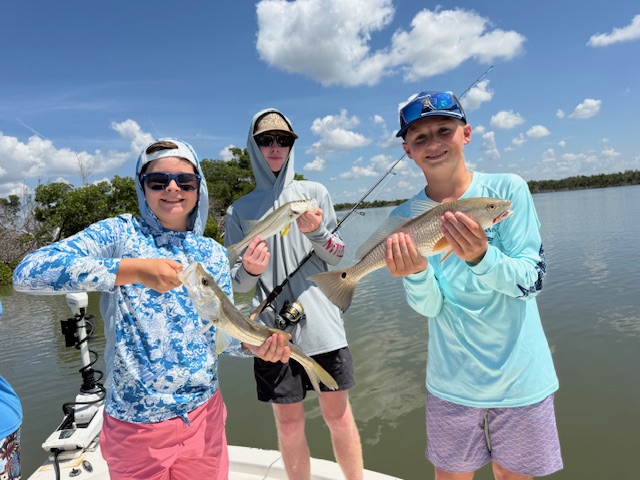
Federal Waters vs. State Waters
Florida state waters extend 9 nautical miles from the Gulf coast and 3 nautical miles from the Atlantic coast. Beyond those distances lies federal water managed by NOAA Fisheries.
Redfish in federal waters: Harvest of red drum in federal waters is prohibited under a federal moratorium. If you catch a redfish in federal water, release it. Nearly all inshore redfish fishing happens well inside state waters, so this rarely affects Fort Myers trips.
Common Questions About Florida Redfish Regulations
What is the redfish slot size in Florida?
18 to 27 inches total length across every FWC harvest region. Under 18 inches must be released. Over 27 inches must be released.
Can you keep a 27-inch redfish in Florida?
Yes. A redfish measuring exactly 27.0 inches total length sits at the top of the legal slot in harvest regions and may be retained. A fish measuring 27.1 inches is over the slot and must be released.
Can you keep a 28-inch redfish in Florida?
No. The upper slot limit is 27 inches statewide. A 28-inch fish is over the slot and must be released. There is no rounding.
How many redfish can you keep per person in Florida?
One redfish per person per day in every harvest region. Vessel limits are 4 fish in the Panhandle, Big Bend, and Northeast regions, and 2 fish in Tampa Bay, Sarasota Bay, Charlotte Harbor, Southwest, and Southeast regions. Indian River Lagoon is catch-and-release only.
How many redfish per boat in Fort Myers?
2 fish per vessel per day. Fort Myers sits in the Charlotte Harbor Region, which caps vessel harvest at 2 regardless of the number of anglers aboard.
How many redfish per boat in Jacksonville?
4 fish per vessel per day. Jacksonville sits in the Northeast Region, which allows a 4-fish vessel limit.
How many redfish per boat in Tampa Bay?
2 fish per vessel per day. Tampa Bay is its own dedicated FWC redfish region with the same 2-fish vessel cap as Charlotte Harbor and the other lower Gulf zones.
Is the Indian River Lagoon catch and release for redfish?
Yes. Every redfish caught in the Indian River Lagoon region must be released regardless of size. The region runs from Lytle Avenue/South Causeway in New Smyrna Beach south to the Palm Beach/Martin county line.
Are Mosquito Lagoon redfish catch and release?
Depends on where in Mosquito Lagoon you fish. Waters south of the Lytle Avenue/South Causeway line in New Smyrna Beach fall under the Indian River Lagoon catch-and-release rule. Waters north of that line sit in the Northeast Region and allow harvest under the standard 18 to 27-inch slot and 1-fish bag / 4-fish vessel limits.
Do captain and crew get a redfish on a charter?
No. FWC rules prohibit captain and crew from retaining redfish while working a for-hire trip. The captain’s bag limit is zero.
Can you gig or spear redfish in Florida?
No. Gigging, spearing, and bowfishing for redfish are prohibited statewide. Only hook and line and cast nets are legal.
Can you use multi-hook rigs for redfish in Florida?
No. Multiple hooks (treble, gang, or similar) combined with live or dead natural bait are prohibited. Single-hook rigs with natural bait are legal.
Can you fillet redfish on the boat in Florida?
No. Redfish must remain with head and tail intact until you reach shore. Removing gills and guts is allowed, which lets anglers bleed a keeper, but filleting on the water is prohibited.
What is the Florida redfish transport limit off the water?
4 redfish per person while transporting fish away from the fishing site in a vehicle. Daily bag and vessel limits still apply at docks and parking lots adjacent to the water.
Can you keep redfish in federal waters in Florida?
No. Harvest of red drum in federal waters (beyond 9 nautical miles in the Gulf and 3 nautical miles in the Atlantic) is prohibited.
What is total length vs fork length for redfish?
Total length measures from the tip of the closed mouth to the tip of the tail with the fins pinched together. Fork length measures to the fork of the tail (a shorter reading). Florida uses total length for the redfish slot; fork length is the wrong method.
Is there a redfish closed season in Florida?
No. Harvest is open year-round in the eight harvest regions. The Indian River Lagoon is catch-and-release only year-round. FWC may issue emergency closures following fish kills or environmental events.
Are Fort Myers redfish in the Southwest Region?
No. Fort Myers, Cape Coral, Sanibel, Captiva, Pine Island Sound, and the surrounding waters fall under the Charlotte Harbor Region. The Southwest Region begins south of Vanderbilt Beach Road in Collier County.
Does Biscayne National Park have special redfish rules?
Yes. The Southeast Region slot and bag rules apply inside Biscayne National Park, but the park adds a separate species aggregate and additional park-specific rules. Verify park regulations before every trip inside park boundaries.
Fishing for Redfish Around Fort Myers
The Charlotte Harbor Region holds some of the most productive redfish habitat anywhere in Florida. Pine Island Sound fishing delivers the largest schooling aggregations in fall. Charlotte Harbor proper, Estero Bay, the Sanibel and Captiva backwater, the Cape Coral canal system, and the Caloosahatchee River all hold strong resident populations year-round.
The peak fall window overlaps directly with the fall mullet run in Southwest Florida, when redfish form some of the largest school aggregations of the year and feed aggressively on migrating bait. Anglers planning trips around species peaks and weather windows benefit from checking the month-by-month calendar for Fort Myers fishing before locking in dates.
For visitors new to Charlotte Harbor Region waters, working with a captain who fishes these flats daily beats trying to figure the region out solo. Sea N Red Charters runs private inshore trips across Fort Myers, Sanibel, Captiva, Cape Coral, and Pine Island Sound with Captain Erik Johnson at the helm, and every trip runs under strict compliance with the current FWC redfish rules covered above. Booking a trusted Fort Myers fishing charter locks in dates during the peak fall window when Charlotte Harbor Region redfish action reaches its annual crescendo.
Whether the goal is a single slot-sized keeper for dinner or a full day of catch-and-release action on schooling bull reds, working with top-rated Fort Myers fishing charters turns a good day into a memorable one.
Sources and Verification
Primary source: FWC Red Drum Regulations.
Regulations change with annual FWC reviews, stock assessments, and emergency orders. Always verify current rules through FWC directly before every trip. This reference covers general FWC redfish regulations and does not replace direct verification with the agency.
Florida’s redfish rules exist to protect a fishery that anglers, captains, and conservation groups have spent decades rebuilding. Know your region. Measure carefully. Release the fish that need to swim away. And enjoy one of the finest inshore fisheries anywhere in the world.