
The short answer: Goliath grouper is a strictly protected giant that can only be legally harvested through a state lottery permit system, while other grouper species (gag, red, black, and scamp) are the standard harvest targets that fill Southwest Florida coolers year-round. If you hook something that feels like it grabbed your line and dove into a shipping container, it is almost certainly a Goliath, and it needs to go back in the water. If you hook a hard-pulling fish that heads straight for a rock ledge and fights like a bulldog on a chain, you are into a keeper-class Gag, Red, or Black grouper.
Understanding the difference matters for three reasons. First, it is the law. Florida Fish and Wildlife Conservation Commission (FWC) regulations distinguish sharply between protected Goliaths and harvestable grouper species. Second, the tackle you need for a 500-pound Goliath is completely different from the setup that produces on 15-pound Red grouper. Third, the locations where each species holds are different, meaning your fishing plan changes based on which species you actually want to target.
This complete guide covers the goliath grouper vs grouper comparison in Southwest Florida, including how to identify each species, where they hold, the exact current regulations, the lottery permit system that governs Goliath harvest, the tackle setups for each, and the tactics that produce fish in Fort Myers, Sanibel, Captiva, and the broader SWFL fishing grounds.
Meet the Goliath Grouper: The 800-Pound Giant

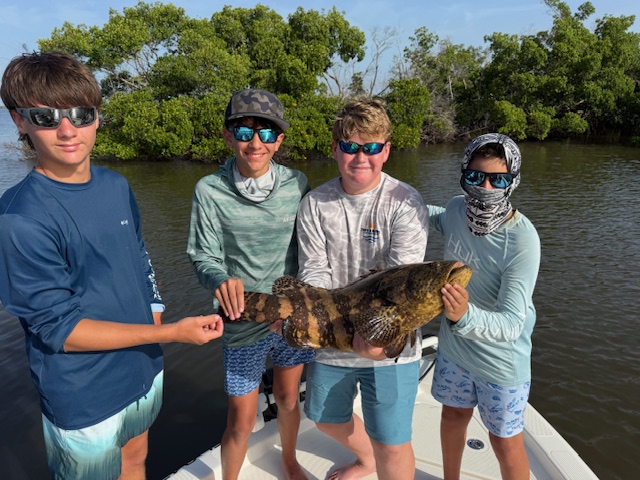
The Atlantic Goliath grouper (Epinephelus itajara), formerly known as the Jewfish, is the largest grouper species in the Atlantic Ocean. These are prehistoric-looking bottom dwellers with massive rounded heads, small forward-set eyes, and a body built for raw power rather than speed.
How big do Goliath grouper get? Adults commonly reach 400 to 500 pounds. Verified specimens exceed 800 pounds. The largest ever recorded weighed over 1,000 pounds. In Southwest Florida waters, anglers regularly encounter Goliaths in the 100 to 300-pound range, with fish over 400 pounds landed every season around wrecks, bridges, and deep structure.
Life history: Goliaths live 30 to 40 years. They start life in the mangrove estuaries of Southwest Florida, spending their first 5 to 7 years as juveniles hiding among mangrove roots in Ten Thousand Islands, Charlotte Harbor, and Estero Bay. As they mature, they move offshore to occupy artificial reefs, natural ledges, deep passes, and shipwrecks. Mature Goliaths spend their entire adult lives on the same piece of structure, defending it against other Goliaths.
Distinctive features:
- Massive rounded body with a wide head that looks disproportionately large for the fish
- Small eyes positioned forward on the head
- Rounded tail fin (this is the fastest identification feature that separates Goliaths from Gag and Black grouper)
- Mottled brown, olive, and yellow coloration with small dark spots scattered across the body
- Juveniles have bold dark vertical bars that fade as the fish matures
- Massive gaping mouth capable of inhaling small tarpon, large jack crevalle, and stingrays
Where you find them in SWFL: Juveniles (20 to 100 pounds) live in mangrove creeks, residential canals, under docks, and around bridge pilings in the estuaries. Fort Myers anglers regularly catch juvenile Goliaths right off residential docks in Cape Coral. Adult Goliaths (200+ pounds) hold on nearshore artificial reefs like Edison Reef, deep passes including Redfish Pass and Boca Grande Pass, shipwrecks, and natural limestone ledges 3 to 30 miles offshore. The Sanibel Causeway pilings and Big Carlos Pass structure hold consistent populations of adult Goliaths that anglers target on catch-and-release trips.
Meet the “Regular” Groupers: Your Keeper Species
The species that anglers actually fill their coolers with fall into four main categories in Southwest Florida waters. Each has distinct identification features, habitat preferences, and regulatory treatment.
Gag Grouper
Size: Average 5 to 20 pounds, with larger specimens exceeding 40 pounds. Trophy fish over 60 pounds are landed offshore.
Identification: Gray to brownish body with dark irregular blotches often called “kiss marks” or worm-like patterns. Squared tail with a distinctive white margin. The preopercle (gill cover) has a notched edge with a distinct lobe. Large males develop a copper or bronze belly and are called “rusty bellies” or “copper bellies.”
Habitat: Rocky ledges, offshore reefs, shipping channels, and hard-bottom structure typically in 30 to 200 feet of water. Gags prefer more relief and cover than Reds. Look for them on higher-profile structure with holes and undercuts where they can ambush prey.
Fight characteristics: Aggressive strike followed by an immediate powerful dive back to structure. If you do not turn the head in the first three seconds, they will wedge themselves in the rocks and cut you off. Some of the hardest-fighting reef fish pound-for-pound in the SWFL fishery.
Table fare: Excellent. Firm white flesh with mild flavor. Widely considered one of the best-eating grouper species alongside Black grouper.
Red Grouper
Size: Average 5 to 15 pounds. Fish over 20 pounds are trophy-class. Occasional specimens exceed 30 pounds.
Identification: Reddish-brown body with a slightly sloped forehead. Small white spots scattered across the body. Distinctive scarlet-orange coloration inside the mouth. Squared tail. Local anglers call them “fire trucks” or “garbage mouths” because of their color and their aggressive feeding on virtually anything that hits the bottom.
Habitat: Flat, hard limestone bottom in 30 to 300 feet of water. Reds prefer expansive hard bottom with small potholes and depressions rather than high-relief reef structure. They are ecosystem engineers that use their mouths to blow sand away from limestone holes, creating habitat that other species (snapper, lobster) also use.
Fight characteristics: Strong initial pull with less structure-diving instinct than Gags. Easier to land than Gag or Black grouper because they typically fight in more open water.
Table fare: Excellent. Slightly milder than Gag with the same firm white flesh. Highly prized in Florida restaurants and one of the primary “hook and cook” targets in Fort Myers.
Black Grouper
Size: Average 10 to 40 pounds. Trophy specimens exceed 50 pounds, with rare fish over 100 pounds.
Identification: Dark olive to gray body with rectangular dark blotches (not the worm-like patterns of Gag). Squared tail with a distinctive black margin (not the white margin of Gag). Larger and more powerfully built than Gag. Often confused with Gag but noticeably stockier and darker.
Habitat: Deep reefs and drop-offs in 60 to 250 feet of water. Blacks hold on high-profile structure and hard-bottom areas farther offshore than Reds. Ledge systems, wrecks, and deep reef structure produce the biggest fish.
Fight characteristics: The strongest fighter of the standard groupers. Blacks combine Gag-level structure-diving with more raw power. Landing a big Black requires quality tackle and steady pressure to turn the head early.
Table fare: Excellent. Comparable to Gag and Red for firmness and flavor. One of the most prized eating fish in the Gulf.
Scamp Grouper
Size: Smaller than the other three species. Average 3 to 10 pounds, with larger specimens reaching 15 to 20 pounds.
Identification: Elongated body compared to other groupers. Reddish-brown coloration with scattered dark spots. Distinctive black patch on the corner of the tail.
Habitat: Deep reef edges and drop-offs typically in 120 to 250 feet of water. Scamps hold in deeper structure than Reds and Gags, often on the offshore edges of the nearshore fishery.
Table fare: Widely considered the best-eating grouper species by many chefs and anglers. Firm sweet flesh that some rank above even Gag and Red.

Side-by-Side Comparison Table
| Feature | Goliath Grouper | Gag Grouper | Red Grouper | Black Grouper | Scamp Grouper |
|---|---|---|---|---|---|
| Average Size | 100 to 400+ lbs | 5 to 20 lbs | 5 to 15 lbs | 10 to 40 lbs | 3 to 10 lbs |
| Max Size | 800+ lbs | 60+ lbs | 30+ lbs | 100+ lbs | 20+ lbs |
| Tail Shape | Rounded (fan-like) | Squared with white margin | Squared | Squared with black margin | Elongated with black patch |
| Body Color | Mottled brown/olive/yellow | Gray-brown with kiss marks | Reddish-brown with white spots | Dark olive with rectangular blotches | Reddish-brown with dark spots |
| Habitat | Mangroves (juvenile), wrecks/reefs (adult) | Rocky ledges, reefs, channels | Hard limestone bottom | Deep reefs and drop-offs | Deep reef edges |
| Depth Range | 15 to 160+ feet | 30 to 200 feet | 30 to 300 feet | 60 to 250 feet | 120 to 250 feet |
| Harvest Status | Lottery permit only | Seasonally regulated | Open with limits | Open with limits | Open with limits |
| Minimum Size | 24 to 36 inch slot | 24 inch total length | 20 inch total length | 24 inch total length | 16 inch total length |
| Table Fare | Not recommended (high mercury) | Excellent | Excellent | Excellent | Best in class |
| Fight Difficulty | Extreme (heavy tackle required) | Very hard | Moderate to hard | Hardest of harvestable | Moderate |
Grouper in Florida: The Current Regulations
Grouper fishing in Southwest Florida is managed by two agencies. The Florida Fish and Wildlife Conservation Commission (FWC) regulates state waters (0 to 9 nautical miles from shore in the Gulf). The National Oceanic and Atmospheric Administration (NOAA) manages federal waters (9 to 200 nautical miles). Rules can differ between the two zones, and regulations change annually.
Always verify current regulations at MyFWC.com or through the Fish Rules app before your trip. The rules below reflect the 2026 season.
Gulf State Waters (0 to 9 Nautical Miles)
Aggregate bag limit: 4 grouper per person per day across all grouper species combined. You cannot exceed 4 total groupers regardless of species mix.
Red Grouper:
- Minimum size: 20 inches total length
- Bag limit: 2 per person per day (within the 4-fish aggregate)
- Season: Open year-round (subject to quota-based closures)
Gag Grouper:
- Minimum size: 24 inches total length
- Bag limit: 2 per person per day (within the 4-fish aggregate)
- Season for 2026: September 1 through September 14 in state waters. Federal waters typically open September 1 through October 1. Gag seasons have been drastically shortened due to a stock assessment (SEDAR 72) that identified Gulf Gag populations as overfished.
Black Grouper:
- Minimum size: 24 inches total length
- Bag limit: 4 per person per day (within the 4-fish aggregate)
- Season: Open year-round in Gulf state waters
Scamp Grouper:
- Minimum size: 16 inches total length
- Bag limit: 4 per person per day (within the 4-fish aggregate)
- Season: Open year-round in state waters
Goliath Grouper:
- Harvest prohibited except through the state lottery permit program (see next section)
- Slot for permit holders: 24 to 36 inches only
- Bag limit for permit holders: 1 per year
Additional Requirements
State Reef Fish Angler (SRFA) designation: Required when fishing for reef fish species (including all grouper) from a private vessel in state waters. Free registration through FWC.
Circle hooks required: Non-offset, non-stainless steel circle hooks are mandatory when using natural bait for reef fish species.
Descending device or venting tool required: Must be onboard when targeting reef fish. Used to relieve barotrauma in released fish (more on this below).
Fillet requirements: Grouper must remain whole (head and tail intact) until you reach shore. You cannot fillet fish while on the water because enforcement officers need to verify size and species.
Charter and headboat crew restrictions: Captains and crew on for-hire vessels have a zero bag limit for Gag, Black, and Red grouper in the Gulf. They cannot retain their own daily limits.
Can You Keep a Goliath Grouper? The Lottery Program
For decades after 1990, Goliath grouper harvest was completely prohibited in Florida after the species was nearly wiped out by overfishing in the 1970s and 1980s. Populations recovered under strict protection, and in 2023, FWC implemented a highly regulated recreational harvest program. It is not a normal fishing season. It is a lottery.
How the lottery works:
Application: $10 non-refundable entry fee for the random drawing.
Timing: Lottery drawings typically occur in October for the following spring harvest season.
Permits available: 200 total permits statewide, per year.
Permit cost if selected: $150 for Florida residents. $500 for non-residents.
Harvest allowed with permit: One Goliath grouper per permit holder, per year.
Slot limit: 24 to 36 inches total length only. Fish outside this slot must be released, even by permit holders. Small juveniles under 24 inches and mature adults over 36 inches are protected.
Open season: March 1 through May 31 only.
Gear restrictions: Hook-and-line gear only. No spearing, no gaffs, no nets.
Regional restrictions: Certain areas including Everglades National Park, Dry Tortugas, and select reef areas are excluded from the harvest program. Fish caught in these areas cannot be retained even with a permit.
Zero harvest for charter crews: Captains and crew members on for-hire vessels cannot retain Goliaths under the lottery program.
For the average recreational angler, the practical answer to “can you keep a Goliath grouper” is: no. Without a lottery permit in hand, every Goliath you catch must be released, and the release must follow specific handling rules. The lottery odds are steep, and the fee structure discourages casual applications. The overwhelming majority of Goliath encounters in Southwest Florida are catch-and-release affairs even during the March through May open season.
Goliath Grouper Fort Myers: Where to Find Them
The Fort Myers region holds one of the densest concentrations of Goliath grouper in Florida. Both juvenile and adult populations are abundant, accessible, and consistently productive for catch-and-release trips.
Sanibel Causeway bridge pilings: The concrete structure of the Sanibel Causeway holds resident adult Goliaths that patrol the deep channels beneath the bridges. These fish live under the bridges year-round. Live baits (whole ladyfish, mullet, or small jacks) dropped near the pilings on heavy bottom rigs produce consistent action.
Caloosahatchee River bridges: The Edison Bridge and Midpoint Bridge structures hold juvenile and mid-sized Goliaths. The mixing of freshwater from the river with saltwater creates habitat that these fish exploit year-round.
Redfish Pass: The deep-water pass between Captiva and North Captiva holds massive adult Goliaths in the 200 to 500-pound class. Local captains target these fish on trips specifically dedicated to catch-and-release Goliath hunts.
Boca Grande Pass: The old phosphate dock pilings inside Boca Grande Pass are legendary for adult Goliath encounters. The pass runs deeper than most anglers realize (60+ feet in spots), and the Goliaths use the pilings and current seams as ambush points.
Nearshore artificial reefs: Edison Reef (12 miles off Fort Myers Beach) and several other artificial reef sites hold resident adult Goliath populations. These fish become the “kings” of individual reef structures and can dominate a specific piece of structure for years.
Residential canals and mangrove creeks: Juvenile Goliaths (20 to 100 pounds) live in the Cape Coral canal system, Estero Bay tributaries, and mangrove creeks throughout the region. These smaller fish are the ones anglers most commonly hook while targeting other species.
Ten Thousand Islands: The mangrove estuary south of Fort Myers holds the highest concentration of juvenile Goliaths in the state. Fishing the mangrove roots at high tide produces consistent shots at small Goliaths for anglers with the right tackle.
For anglers targeting these locations, captains running nearshore reef trips out of Fort Myers know exactly which structures hold resident Goliaths and can position for the fight of a lifetime, even on a catch-and-release basis.
Grouper Fishing Nearshore: Where the Keepers Live
For anglers who want to actually bring grouper home for dinner, the target zones and structure are different from where you find Goliaths.
Edison Reef (12 miles offshore): Produces Red and Gag grouper year-round on the artificial structure. Depth of 40 to 60 feet makes this reachable on half-day trips with the right boat.
Nearshore hard bottom (10 to 25 miles offshore): Natural limestone ledges and hard-bottom areas in 40 to 80 feet of water. These are the classic Red grouper zones. Anglers drift over the structure or anchor upcurrent and drop bait to the bottom.
Deep artificial reef complex (25 to 50 miles offshore): Larger Gag and Black grouper hold on deeper artificial reef structures. Requires a bigger boat and calmer weather but produces trophy fish.
Wrecks: Multiple shipwrecks off the Southwest Florida coast hold large concentrations of grouper. Both artificial reef structures and natural wrecks produce.
Deep drop territory (50+ miles offshore, 200 to 1,000+ feet): Snowy, Warsaw, and Yellowedge grouper are the specialized deep-drop targets. This is technical fishing that requires electric reels and specific gear.
For visitors wanting to understand exactly how far these trips actually run, this detailed breakdown of nearshore fishing distances from Fort Myers covers the range for different trip types.
Tackle for Goliath Grouper: Heavy Duty Everything
Goliath grouper fishing tackle is not “large fishing tackle.” It is on a different scale entirely.
Rods: 100 to 150-pound class stand-up rods. Short and stiff with maximum lifting power. A rod that can handle a 200-pound tuna is what you use for a small Goliath.
Reels: Large 2-speed conventional reels with 100+ pounds of drag. Penn International 80 or 130 series, Shimano Tiagra, or similar. The reel must have the capacity to hold 300+ yards of heavy line even on smaller Goliaths.
Main line: 200 to 300-pound braided line. Not fluorocarbon. Not monofilament. Heavy braid provides the strength to turn a large fish before it wedges into structure.
Leader: 400 to 1,000-pound monofilament leader. Yes, thousand-pound. Local captains describe using leader “like thick weedeater line.” Goliaths have massive teeth and abrasive body surfaces that will destroy anything less.
Hooks: 20/0 to 24/0 circle hooks. Non-stainless steel (so they can rust away if the fish breaks off) and non-offset (legal requirement for reef fish with natural bait).
Bait: Large live baits (whole 3 to 8-pound jacks, live ladyfish, small live catfish, whole large mullet, or small live stingrays). Large cut baits work but produce less consistently than live options.
The fight: A Goliath fight is a stand-up battle of leverage. The first three seconds determine whether you land the fish or lose it. If the Goliath reaches structure, the fight is over. You either broke him off or the leader is cut. Getting the fish’s head turned and moving toward the surface requires maximum pressure applied immediately after the hook set.
Release procedure: Large Goliaths cannot be removed from the water. Their skeletal structure cannot support their body mass without water buoyancy. Removing a 300-pound Goliath from the water causes internal organ damage and often death. Regulations require adult Goliaths to remain in the water at all times during release. Cut the leader as close to the hook as safely possible and let the fish swim off. The circle hook will rust out within weeks.
Tackle for Keeper Groupers: Serious But Not Extreme
Standard grouper tackle is substantial but nothing like the equipment required for Goliaths.
Rods: Medium-heavy to heavy conventional or heavy spinning rods rated for 50 to 80-pound line. Length typically 6.5 to 7.5 feet with a stout backbone.
Reels: Conventional reels (Shimano Torium, Penn Torque, Avet) with strong drag systems. Spinning reels in 6000 to 10000 size work for lighter grouper fishing on structure closer to shore.
Main line: 50 to 80-pound braided line. Braid’s zero stretch allows instant hook sets that turn the fish before it reaches cover.
Leader: 60 to 100-pound fluorocarbon leader in 3 to 6-foot lengths. Fluorocarbon’s abrasion resistance handles rock structure. Connect leader to main line with a heavy barrel swivel or an FG knot.
Hooks: 5/0 to 9/0 non-offset circle hooks depending on bait size.
Rigs:
Knocker rig: A sliding egg sinker sits directly on the leader against the hook. Simple, effective, and delivers maximum sensitivity to the strike. Weight sizes typically 4 to 8 ounces for nearshore reef work.
Carolina rig: Sliding sinker stopped by a barrel swivel, with a 3 to 6-foot leader below. Allows more natural bait movement. Preferred for Red grouper on flatter bottom.
Chicken rig: Multiple droppers off a heavy weight for covering different water depths simultaneously. Common on deep drop trips.
Best baits: Live pinfish and grunts are the top choices for Gag and Black grouper. Live sand perch and small live bait fish produce well. Cut bait (squid, mullet chunks) works especially well on Red grouper because Reds are more opportunistic feeders. Fresh always outproduces frozen.

Barotrauma: Critical for Released Grouper
Any grouper caught from water deeper than about 30 feet is at risk of barotrauma. The rapid pressure change during retrieval causes the swim bladder to expand, forcing internal organs out of position and creating a life-threatening condition.
Signs of barotrauma:
- Stomach protruding from the mouth
- Eyes bulging outward
- Fish floats belly-up when released
- Fish cannot swim back down
Descending devices: The preferred barotrauma treatment. A descending device (SeaQualizer, RokLees, weighted release clips) attaches to the fish’s lower jaw and carries it back to depth. At the correct depth, the device releases automatically, and the fish swims off as its swim bladder recompresses naturally. Descending devices dramatically improve release survival rates compared to venting.
Venting tools: A hollow needle inserted between the fish’s fins to release gas from the swim bladder. Less preferred than descending devices because it creates a wound that increases infection risk, but still an approved method.
Legal requirement: Florida law requires anglers targeting reef fish (including grouper) to carry either a descending device or venting tool on the boat. FWC officers check for this equipment during dock inspections.
Free descending devices: The Return ‘Em Right program (returnemright.org) provides free descending devices to anglers along with training on proper technique. Highly recommended for anyone doing regular grouper fishing.
Handling protocol: Minimize air exposure. Use wet hands or a rubber glove. Support the fish’s body when lifting. Deploy the descending device or venting tool quickly. Return the fish to the water within 60 seconds when possible.
Charter Options for SWFL Grouper Fishing
The right charter for grouper fishing depends on which species you want and how far you want to run.
Half-day nearshore reef trips (4 to 6 hours): Targets Red grouper and mangrove snapper on structure 5 to 15 miles offshore. Trip length allows time to reach the reef, fish it thoroughly, and return within reasonable distance of the dock. Pricing runs $700 to $1,000. Perfect format for families and beginners.
Full-day nearshore trips (7 to 8 hours): Reaches deeper Gag and Black grouper structure 15 to 30 miles offshore. More time on the water means more spot rotation and higher catch potential. Pricing runs $1,000 to $1,400.
Full-day offshore trips (8 to 10 hours): Targets trophy Gag, Black grouper, and other deep species 30 to 50 miles offshore. Requires calm weather and a boat rated for the run. Pricing runs $1,400 to $1,800.
Deep drop trips (10+ hours): Specialty trips for Snowy, Warsaw, and Yellowedge grouper in 400+ feet. Electric reels typically required. Pricing runs $2,000+.
Goliath grouper catch-and-release trips (6 to 8 hours): Specialty trips using heavy tackle to target adult Goliaths on wrecks, bridges, and passes. Pure sport fishing since harvest requires a lottery permit. Pricing runs $1,200 to $1,600.
Family reef trips: Many operators run modified reef trips designed for family groups with kids. These typically stay closer to shore, target mixed species (Red grouper, snapper, various snapper species), and focus on steady action rather than trophy fish. Sea N Red charters offers the best Fort Myers fishing charter trips for families with formats designed to keep kids engaged and comfortable while still producing quality fish.
For a broader picture of what species you might encounter alongside grouper on a Southwest Florida reef trip, our complete guide to Fort Myers fish species breaks down every major target from the shallow flats to the deep offshore structure.
Booking a Trip Around Grouper Seasons
Timing your trip to align with open harvest windows makes a significant difference in the value you get.
October through April: The best window for Red and Black grouper harvest in state waters. Both species are open year-round in Gulf state waters, but the fish move closer to shore during cooler months, making them more accessible on shorter trips.
September (first two weeks): The narrow window when Gag grouper is open for harvest in Gulf state waters. Book early, as these dates fill quickly among serious grouper anglers who want to include Gags in their catch.
March through May: Spring warming brings grouper closer to nearshore structure. Also the only window for legal Goliath harvest through the lottery program.
Summer months: Grouper move to deeper cooler water during peak summer heat. Nearshore trips require longer runs to reach fish. However, the Red grouper bite on hard bottom stays consistent through summer if you can reach 60+ feet of depth. Bring your catch to a Fort Myers dockside restaurant afterward for a hook-and-cook meal that turns your fish into dinner within hours of the boat hitting the dock.
For visitors trying to align their travel dates with the best grouper opportunities, working with a reliable Fort Myers fishing charter that specializes in nearshore reef trips ensures your trip is scheduled during the seasons and moon phases that maximize your shot at a legal keeper.
For a full-service saltwater trip that combines grouper fishing with other reef species, a mixed saltwater charter delivers the flexibility to chase whatever is biting best on your specific dates.
Frequently Asked Questions
What is the difference between a Goliath grouper and a regular grouper?
Size and legal status are the biggest differences. Goliaths reach 800+ pounds and are strictly protected under an FWC lottery permit system. Regular groupers (Gag, Red, Black, Scamp) reach 5 to 50 pounds and can be harvested under standard seasonal, size, and bag limits. Goliaths have rounded tails; regular groupers have squared tails.
Can you keep a Goliath grouper in Florida?
Only if you win an FWC lottery permit. The program awards 200 permits per year statewide through a random drawing. Application fee is $10. Permit cost is $150 for residents, $500 for non-residents. Season runs March 1 through May 31 only. Slot limit is 24 to 36 inches. Without a permit, every Goliath must be released.
How big do Goliath grouper get?
Adult Goliaths commonly reach 400 to 500 pounds. Verified specimens exceed 800 pounds, with the largest ever recorded topping 1,000 pounds. In Fort Myers waters, anglers regularly encounter fish in the 100 to 300-pound range on wrecks, bridges, and deep passes.
Where can I catch Goliath grouper in Fort Myers?
Sanibel Causeway pilings, Caloosahatchee River bridges, Redfish Pass, Boca Grande Pass, nearshore artificial reefs, and residential canals throughout Cape Coral. Juvenile Goliaths inhabit mangrove creeks and canals throughout the region. Adults hold on wrecks and deep passes.
What is the best bait for Goliath grouper?
Large live baits including whole 3 to 8-pound jacks, live ladyfish, small live catfish, whole large mullet, and small live stingrays. Adult Goliaths eat prey the size of small tarpon, so oversized baits produce best.
What are the current grouper regulations in Florida?
For 2026 in Gulf state waters: Red grouper (20-inch minimum, 2 per person daily, open year-round). Gag grouper (24-inch minimum, 2 per person daily, September 1 through 14 only). Black grouper (24-inch minimum, 4 per person daily, open year-round). Scamp grouper (16-inch minimum, 4 per person daily, open year-round). Overall aggregate limit is 4 groupers per person per day across all species. Always verify current rules at MyFWC.com before your trip.
Which grouper is the best eating fish?
Scamp is widely considered the best-tasting grouper by chefs and serious anglers. Red, Gag, and Black grouper are all excellent and virtually interchangeable in most preparations. All four have firm white flesh with mild flavor that works well grilled, blackened, pan-seared, or fried.
Do you need a special license to fish for grouper?
A standard Florida saltwater fishing license is required. Anglers fishing for reef fish from a private boat must also register in the free State Reef Fish Angler (SRFA) program. Charter clients are covered under the captain’s license. Goliath harvest requires a separate lottery permit as described above.
Southwest Florida offers world-class grouper fishing across every size and skill level, from the 20-pound Red grouper that fills the cooler on a family reef trip to the 400-pound Goliath that peels drag on heavy stand-up tackle. Know your species. Follow the regulations. Bring the right tackle for what you actually want to catch. And whether you are chasing a keeper for dinner or a trophy catch-and-release fight, Fort Myers has the structure, the fish, and the captains to make the trip a success.


